'%3e%3cpath%20d='M72%200H0V72H72V0Z'%20fill='%23D81E04'/%3e%3cpath%20d='M16.656%2048.9837C13.5894%2048.9837%2011.0957%2051.4736%2011.0957%2054.5308C11.0957%2057.5879%2013.5875%2060.0797%2016.656%2060.0797C19.7244%2060.0797%2022.1917%2057.5784%2022.1917%2054.5308C22.1917%2051.4831%2019.6999%2048.9837%2016.656%2048.9837ZM16.656%2056.7087C15.4498%2056.7087%2014.4667%2055.7294%2014.4667%2054.5308C14.4667%2053.3321%2015.4498%2052.3528%2016.656%2052.3528C17.8622%2052.3528%2018.8302%2053.3321%2018.8302%2054.5308C18.8302%2055.7294%2017.8376%2056.7087%2016.656%2056.7087ZM54.0881%2049.2446H50.8306V59.7961H54.1335V55.8863C54.1335%2055.4609%2054.1297%2054.9013%2054.0257%2054.2226L57.6349%2059.798H60.9056V49.2465H57.6046V53.0088C57.6046%2053.4664%2057.6179%2054.0241%2057.7143%2054.6877L54.0881%2049.2465V49.2446ZM43.5404%2023.2733L48.628%2028.361C50.7852%2030.5068%2054.7668%2030.798%2057.3381%2028.2456L48.5184%2019.426L47.9758%2018.8871C45.8186%2016.7394%2042.9297%2015.5332%2039.8859%2015.5332H31.6485C28.0393%2015.5332%2024.9576%2018.1895%2024.4623%2021.7571H39.8915C41.266%2021.7571%2042.5724%2022.294%2043.5404%2023.2715V23.2733ZM32.4879%2024.3397C32.4879%2025.9977%2033.8359%2027.3457%2035.494%2027.3457C37.1521%2027.3457%2038.5001%2025.9996%2038.5001%2024.3397C38.5001%2023.8008%2038.3583%2023.2658%2038.0728%2022.7969H32.9057C32.6335%2023.2658%2032.4879%2023.8008%2032.4879%2024.3397ZM33.6979%2049.2446V59.7961H40.6988V56.928H37.3789V49.2465H33.6979V49.2446ZM21.2577%2029.0208H24.2354C25.2998%2029.0208%2026.3869%2029.4727%2027.1507%2030.2289L41.249%2044.3309C43.6784%2041.9147%2043.6784%2037.9293%2041.249%2035.5094L31.6315%2025.8899C29.6671%2023.9199%2027.0373%2022.7969%2024.2619%2022.7969H23.3582C19.9078%2022.7969%2017.1267%2025.5875%2017.1267%2029.0359C17.1267%2030.382%2017.5275%2031.4181%2018.2119%2032.5581C17.9605%2030.7167%2019.3917%2029.0208%2021.2558%2029.0208H21.2577ZM45.2344%2055.6008H47.4634V53.1525H45.2344V51.8215H49.3597V49.2427H41.8332V59.7942H49.6981V56.9262H45.2344V55.6008ZM29.8505%2055.4969C31.0397%2055.357%2031.8262%2054.3096%2031.8262%2052.8027C31.8262%2050.5473%2030.4158%2049.2446%2027.6801%2049.2446H23.3639V59.7961H26.6667V56.3079L28.459%2059.7961H32.5919L29.8505%2055.4969ZM27.3039%2054.1451H26.6667V51.8518H27.3039C28.1074%2051.8518%2028.5233%2052.2998%2028.5233%2053.0202C28.5233%2053.7405%2028.0866%2054.1451%2027.3039%2054.1451Z'%20fill='white'/%3e%3c/g%3e%3cdefs%3e%3cclipPath%20id='clip0_477_203'%3e%3crect%20width='72'%20height='72'%20fill='white'/%3e%3c/clipPath%3e%3c/defs%3e%3c/svg%3e)
- Home
- Management Report
- Our Performance in 2025
- Upstream & Supply
Upstream & Supply
We are active in natural gas and crude oil production in Poland, Norway, Pakistan, Canada and Lithuania. In 2025, our production volume totalled 74 million boe. In addition to extracting hydrocarbons and preparing products for sale, ORLEN Group companies specialise in oil and gas exploration and development of new fields, as well as in geological analyses, geophysical surveys and drilling operations.
We are the largest supplier of natural gas in Poland, with wholesale sales reaching most of the key sectors of the Polish economy. Our gas sales business is also being actively expanded abroad, including in Germany, Lithuania and the Baltic states. We source oil and gas from own production and imports. The ORLEN Group is Poland’s largest importer of crude oil.
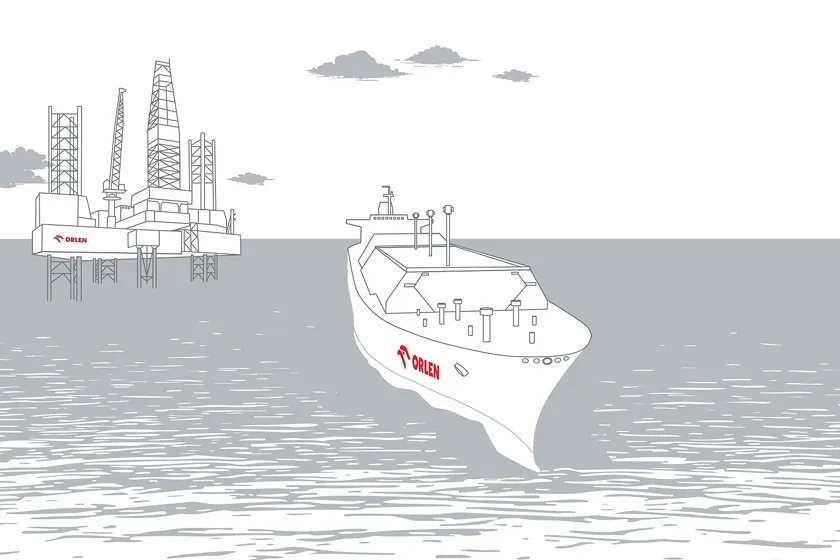
ORLEN Group business model by segment

Financial results
Financial highlights of the Upstream & Supply segment
| [PLN million] | 2025 | 2024 | change |
|---|---|---|---|
| Segment revenue, including: | 144,428 | 169,262 | (24,834) |
| Revenue from external customers | 53,802 | 59,179 | (5,377) |
| Inter-segment revenue | 90,626 | 110,083 | (19,457) |
| Segment costs | (133,686) | (158,752) | 25,066 |
| Other operating income | 3,774 | 5,369 | (1,595) |
| Net other operating income/(expenses) | (5,825) | (3,428) | (2,397) |
| (Impairment loss)/ reversal of impairment loss on trade and other receivables | (54) | (105) | 51 |
| LIFO-based EBITDA excluding impairment losses | 16,275 | 18,493 | (2,218) |
| LIFO-based EBITDA | 14,188 | 18,336 | (4,148) |
| EBITDA | 13,920 | 18,101 | (4,181) |
| Operating profit (EBIT) | 8,637 | 12,346 | (3,709) |
| Capex | 8,654 | 7,646 | 1,008 |
LIFO-based EBITDA by business line [PLN billion]
Upstream
PLN 14.3 billion [up PLN 13.6 billion year on year]
- (+) higher prices of gas
- (-) decline in oil prices
- (-) narrower TTF–Henry Hub spread
- (-) appreciation of the PLN against the NOK
Supply
PLN 2.0 billion [down PLN 15.8 billion year on year]
- (+) higher wholesale gas sales volumes
- (-) lower realised gas selling price
- (-) negative effect of the 2024 PPA settlement
Upstream operations
ORLEN Group’s 2025 oil and gas production volumes by country [thousand boe]

ORLEN Group’s reserves by country (as at 31 December 2025) [million boe]
| Crude oil, condensate, NGL | Natural gas | |
|---|---|---|
| 322.7 | 921.7 | |
| Poland | 121.7 | 552.0 |
| Norway | 118.0 | 271.2 |
| Canada | 82.1 | 60.2 |
| Pakistan | 0.0 | 38.3 |
| Lithuania | 0.8 | 0.0 |
In 2025, the ORLEN Group’s reserves-to-production (R/P) ratio was 16.9.
Hydrocarbon reserves in Poland by field at year-end 2025 [million boe]
In 2025, we continued crude oil and natural gas exploration and appraisal projects in the Carpathian Mountains, Carpathian Foothills, Przedsudecka Monocline, Polish Lowlands, and the Kraków, Gdańsk and Poznań Oil Provinces. As at 31 December 2025, we held 41 licences: 34 combined (exploration, appraisal, and production) licences and 7 exploration and appraisal licences for crude oil and natural gas.
Within the Płotki licence area in the Province of Poznań, work is ongoing on the Siedlemin field, discovered under a joint project of ORLEN S.A. and ORLEN Upstream Polska. In February, the field’s reserves were confirmed. Following production tests, they were estimated at over 1.2 million boe of natural gas. The swift commencement of production from this new find will be facilitated by the extensive extraction infrastructure in the region.
In April, gas production was launched from the Grodzewo field in the Province of Poznań as part of a joint project of ORLEN and ORLEN Upstream Polska. The field is expected to remain in production for around 18 years, and its total reserves are estimated at approximately 1.3 mcm.
In August, following the drilling of another well at the Trzebusz field in the Province of Szczecin, the recoverable natural gas reserves increased by 2.4 million boe. Once brought on stream, the field will contribute up to 0.1 million boe of gas annually. Total natural gas reserves in the area rose to 7.7 million boe.
In December, we started production from the Różańsko field in the Province of Szczecin, with gas reserves estimated at 6.2 million boe. The project is linked to the expansion of the Dębno oil and gas production site, which will also make it possible to increase output from other producing fields. With the Różańsko project, our domestic natural gas production will rise by approximately 0.7 million boe annually.
Under the Edge project, wells at the Tuchola natural gas field were decommissioned between October and December. In addition, production from five other fields was discontinued in 2025.
We reached final depth in 18 out of the 20 wells drilled in 2025, with a total drilled length of 43.266 km. These included 5 exploration wells, 6 appraisal wells, and 7 production wells. Formation test results were obtained from 18 wells, of which 11 were positive.
Number of oil and gas production sites
| Sanok | Zielona Góra | |
|---|---|---|
| Gas production sites | 18 | 8 |
| Oil production sites | 5 | 1 |
| Oil and gas production sites | 11 | 7 |
| Total | 34 | 16 |
We operate on the Norwegian Continental Shelf through ORLEN Upstream Norway (“ORLEN UN”, “OUN”). As at the end of 2025, OUN held interests in 94 licences, including 5 licences where it is the operator. Following the annual licensing round (APA 2025) in early 2026, OUN was offered interests in 6 new licences.
Upstream Norway’s asset portfolio* at year-end 2025 [mm boe]
* 2P+2C
In May 2025, OUN discovered the E-prospect field in the Skarv area, with reserves estimated at 3–7 million barrels of oil equivalent. During drilling, an additional smaller accumulation containing up to 2 million boe was found. We hold an 11.9% interest in the licence. Its area is adjacent to the Skarv field, which is expected to significantly facilitate future development of the new reserves.
In June, OUN and its licence partners decided to proceed with the development of the Øst Frigg field. Production from the site continued since the 1980s, but was suspended in the late 1990s once the resources had been depleted. A well drilled in May 2023 resulted in the discovery of oil reserves estimated at 51–103 million boe. These will be brought on stream as part of the Yggdrasil area, which is currently under development, improving the project’s economics and extending the area’s production life. Also in June 2025, OUN completed Phase 3 of the development of Ormen Lange, in which it holds a 14% interest. The project is expected to increase production volumes by a further 4– 7 bcm.
In August 2025, OUN and its licence partners announced the discovery of the Omega Alpha oil field, with reserves estimated at 96–134 million boe, of which 10.5–15 million boe is attributable to the ORLEN Group. Omega Alpha may be brought on stream as part of development work in the Yggdrasil area.
In September 2025, ORLEN UN started production from the Andvare discovery in the Norwegian Sea, formally part of the Alve field, which will provide us with 1.9 million boe of natural gas.
In October 2025, OUN announced an agreement with TotalEnergies EP Norge to acquire all interests in the Tommeliten Gamma field in the Ekofisk area. As a result, we expanded our interest in the field from 42.4% to 62.6% and our reserves, mainly natural gas, rose by approximately 5 million boe.
In December 2025, OUN finalised a transaction with DNO to acquire 7.6% interests in the Albuskjell and Vest Ekofisk fields, increasing the Group’s reserves by more than 7 million boe. In the past, production from these fields was halted in the 1990s following the redevelopment of infrastructure in the Ekofisk area. Now, the licence partners have decided to resume operations on three fields using new technologies designed to improve efficiency and reduce operating costs. Production under the Previously Produced Fields project is scheduled to begin in the fourth quarter of 2028.
OUN also agreed to sell a 20% interest in exploration licence PL1135 and a 0.83% interest in the Verdande field to DNO. Verdande’s reserves attributable to OUN amounted to 0.35 million boe and consisted predominantly of crude oil.
At the end of 2025, OUN produced hydrocarbons from 20 fields in total, and continued development projects on a further 6, with production scheduled to commence in 2026–2027.
Five exploration and appraisal wells were drilled in 2025, resulting in the discovery of an estimated 99–141 million boe of hydrocarbons, with OUN’s share ranging from 11.0 to 16.09 million boe. The total drilled length was 69.1 km for exploration and appraisal wells, and 126.1 km for production wells.
Following the acquisition from TotalEnergies and DNO of interests in three gas fields: Albuskjell, Tommeliten Gamma and Vest Ekofisk, OUN’s hydrocarbon reserves increased by a further 12 million boe. At the end of 2025, they totalled 389.2 million boe, with natural gas accounting for nearly 70% of the volume (270.5 million boe)
We conduct exploration and production activities in Alberta, with all output from the Canadian fields sold on the local market. Our key production assets are in the Kakwa area (Montney formation) and the Ferrier and Lochend areas (Cardium formation), and include primarily unconventional tight oil and tight gas projects using horizontal production wells and the multi-stage hydraulic fracturing technology. These areas gave been well appraised and carry low geological risk.
In 2025, ORLEN Upstream Canada maintained the steady pace of development seen in previous years across its key assets in northern and southern Alberta. During the year, drilling began on a total of 13 wells: 3 in the Kakwa area, including 1 water disposal well (the project is expected to deliver savings in the region of CAD 6–8 million annually, driving profits and margins), 8 wells in the Ferrier area, and 2 in the Lochend area.
In total, 14 wells were completed and brought on stream in 2025.
Our exploration and production activities in Pakistan are conducted under a hydrocarbon exploration and production agreement for the Kirthar licence area. In 2025, our production operations at the Rehman, Rizq, and Rayyan fields relied on a total of 13 wells. As part of the development of the Rehman and Rizq fields, drilling continued on the Rizq-6 production well, while preparations began for the Rehman-9 production well. We also commenced testing of the Rafat-1 exploration well with to document additional reserves. In total, approximately 3.4 km was drilled in the Rizq-6 well in 2025.
With a view to expanding our exploration activities, we acquired a 59% interest, together with operatorship, in the highly promising Baran licence, valid for three years from December 2023. Seismic surveys carried out in 2025 produced approximately 390 km of 2D seismic lines, and we started acquisition of 687 km2 of 3D seismic data. The acquisition campaign will continue until mid- 2026. In addition, we hold a 25% interest in the Musakhel exploration licence, where the first well is expected to be drilled in late 2026.
We currently own and operate seven underground storage sites for high-methane gas:
- five depleted-field storage facilities: Wierzchowice UGSF, Strachocina UGSF, Husów UGSF, Swarzów UGSF and Brzeźnica UGSF (in depleted oil and gas fields),
- two cavern gas storage facilities – Kosakowo UGSF and Mogilno UGSF (in depleted salt caverns),
with a combined capacity of approximately 3.3 bcm.
Their primary purpose is to balance seasonal fluctuations in demand by enabling gas to be injected in summer and withdrawn during periods of higher consumption. Depleted-field storage provides stable, long-term support for the transmission system, while cavern storage facilitates a very rapid response to short-term changes in demand. The storage system plays a key role in safeguarding Poland’s energy security and ensuring flexible balancing of gas supplies.
Our Upstream operations are complemented by two nitrogen-rich gas storage facilities: Daszewo UGSF and Bonikowo UGSF, with a combined working capacity of 250 mcm.
Their main role is to support the operation of the nitrogen-rich gas system and store gas from nitrogenrich gas production facilities.
In March 2025, ORLEN and Equinor signed an agreement to cooperate in a number of areas, including carbon dioxide transport and storage in Poland. The carbon storage project would help curb CO2 emissions into the atmosphere, supporting industrial decarbonisation. The parties will identify potential CO2 storage locations in Poland and in the Polish part of the Baltic Sea. The next step will be to analyse the feasibility of joint projects based on the selected prospective storage sites in Poland.
We provide drilling and oilfield services, along with innovative geophysical, geotechnical, geological and hydrogeological solutions for geological structure exploration. Our services support the broadly defined multi-energy sector, in particular oil and natural gas exploration, renewable energy projects (including geothermal and offshore wind), offshore and onshore infrastructure, nuclear energy, and underground storage facilities, both in Poland and internationally.
Supply operations
Wholesale operations in the gas market
Structure of gas sales to customers outside the ORLEN Group [TWh]
| 2025 | 2024 | |
|---|---|---|
| Poland, including: | 203.2 | 169.9 |
| Polish Power Exchange (POLPX) | 130.3 | 103.9 |
| Foreign countries | 57.5 | 37.1 |
We specialise in the wholesale distribution of natural gas produced from fields in Poland and imported via pipelines and by sea. Our natural gas and LNG trading activities are conducted through dedicated departments. ORLEN also supplies natural gas for its own production needs and to other ORLEN Group companies.
We holds licences for trading in gaseous fuels, trading in natural gas abroad, liquefaction of natural gas and regasification of liquefied natural gas, as well as gas storage.
Imports
In 2025, we purchased natural gas mainly under the long-term contracts and agreements specified below:
- gas sale contracts with Equinor ASA Group companies, with deliveries contracted for the period from 1 January 2023 to 1 January 2033;
- liquefied natural gas sale contract with QatarEnergy LNG N(3), effective until mid-2034;
- liquefied natural gas sale contract with Cheniere Marketing International LLP, effective until 2042;
- liquefied natural gas sale contract with Venture Global Calcasieu Pass, effective until 2042.
To transport LNG contracted on a FOB basis, ORLEN LNG Trading Limited charters LNG carriers. In 2025, the fleet was expanded to include two new vessels: Józef Piłsudski and Ignacy Paderewski, each with a capacity of approximately 174,000 cubic metres. Each of them can carry a cargo of about 70,000 tonnes of LNG, equivalent to about 1.1 TWh of regasified natural gas.
Number of LNG deliveries in 2025 by contract
| Contracts | Venture global | Qatargas I | Qatargas II | PST (spot) | Cheniere | Total |
|---|---|---|---|---|---|---|
| Q1 | 0 | 3 | 1 | 12 | 4 | 20 |
| Q2 | 3 (including 1 delivery to Lithuania) | 1 | 2 | 9 | 6 | 21 (Świnoujście 20, Kłajpeda 1) |
| Q3 | 6 | 3 | 2 | 4 | 5 | 20 |
| Q4 | 4 | 4 | 1 | 7 | 5 | 21 |
In 2025, our import capabilities were expanded with the completion the Świnoujście LNG terminal upgrade. The terminal’s maximum regasification capacity exceeded 90 TWh.
Overall, we received 81 LNG deliveries at the Świnoujście terminal in 2025, with a total volume of 5.99 million tonnes, equivalent to about 91.6 TWh. This marked a significant increase compared with 2024, when imports through the terminal totalled 70.2 TWh.
Natural gas from fields on the Norwegian Continental Shelf, sourced from our own production and under contracts with other producers, is transmitted via the Baltic Pipe. Supplies to the Polish market are secured through long-term capacity bookings, complemented by short-term bookings made against available surplus capacity. The structure of our gas supply portfolio and transmission capacity bookings makes it possible to adjust deliveries to changes in demand, for example during periods of higher consumption. We have booked transmission capacity on the Baltic Pipe until 2037. We also have access to Danish underground gas storage facilities, which help stabilise supplies during maintenance shutdowns or other disruptions along the transmission route.
Wholesale gas sales in Poland
In 2025, we continued supplying natural gas to Poland’s largest industrial customers across key sectors. Our strategic customers include Grupa Azoty S.A. and its subsidiaries, the PGE Group, the ArcelorMittal Group, and KGHM Polska Miedź.
Beyond these major contracts, we entered into numerous gas supply contracts with both existing and new customers. Gas is sold at market prices, and the pricing formulas under the contracts allow customers to develop their own price hedging strategies. The formulas follow a standardised and objective methodology.
In 2025, our high-methane grid gas sales reached 198.6 TWh, a 16% increase from 171.2 TWh in 2025.
In 2025, we also supplied approximately 8.2 GWh of natural gas at the Polish-Lithuanian border.
In 2025, the volume of our gas sales on POLPX (calculated after the delivery date in 2025) was approximately 130.3 TWh, up by some 26.4 TWh year on year.
We continued to develop our small-scale LNG business in 2025, delivering liquefied natural gas via cryogenic tanker trucks to regasification facilities and stations without access to the national gas transmission or distribution network. With 11 tanker trucks filled at the LNG terminal in Świnoujście in 2025, we nearly matched the 2024 figure. The aggregate amount of LNG we placed on the market was 212 thousand tonnes, of which 192 thousand tonnes was sourced through Świnoujście and 20 thousand tonnes came from facilities in Odolanów and Grodzisk Wielkopolski.
Ticketing service
In 2025, we contracted the Government Strategic Reserves Agency (RARS) to maintain part of our mandatory natural gas reserves.
In September 2025, an annex was signed to extend the contract for the following year.
Furthermore, we took part in the RARS ticketing service application process, and in September 2025 we signed a contract securing maintenance of mandatory gas reserves for the period from 1 October 2025 to 30 September 2026.
Through the ORLEN Energy Trading Group (the “OET Group”), we have been expanding our presence in Europe in three key areas: global LNG trading, access to the European gas market, and wholesale activities on the markets of Central and Eastern Europe. In 2025, the OET Group sold 147.4 TWh of pipeline gas (including 50.1 TWh sourced from ORLEN Upstream Norway), 60.2 TWh of LNG (including sales under the contract with Venture Global), and 1.4 TWh of electricity, in commodity exchange trades and other transactions.
In 2025, the OET Group completed 58 LNG deliveries totalling 60.2 TWh (including sales under the Venture Global contract), of which around 76% was delivered to the LNG terminal in Świnoujście. Performance of the long-term contract with Venture Global commenced in April 2025. Under that contract, 14 LNG deliveries were received from the port of Calcasieu Pass. During the year, the OET Group supplied LNG to customers on three continents, including in the United Kingdom, Germany, Turkey, Egypt, Japan and China. The OET Group has contracted regasification capacity at the Montoir LNG terminal in France until 2029. In 2025, three deliveries were executed using the terminal, while 50% of the remaining capacity was sold on the market to optimise operating costs. The OET Group actively managed its contracted shipping capacity, using it to transport LNG cargoes for third parties.
ORLEN Energy Trading GmbH (“OET”), a company of the OET Group, operates on all major commodity exchanges in Europe. Under two contracts, OET receives significant volumes of gas produced from the Tyra field on the Danish Continental Shelf (“DCS”). It also sources gas from nine different producers on the Norwegian Continental Shelf and ships it mainly to Denmark, Germany, the United Kingdom and France.
In Central and Eastern Europe, OET was particularly active in Slovakia and Ukraine, where it won tender procedures for gas supplies to Ukraine. In the Baltic states, it strengthened its position through trading on the Lithuanian exchange, where it acted as an important liquidity provider. It also became a key trading partner for local counterparties and continued its activity on the GET Baltic exchange for Lithuania, Latvia and Estonia. The company won a storage capacity auction in Latvia, leveraged its storage assets for trading, and ensured the partial utilisation of ORLEN’s regasification capacity with KN Energies for 2025 and the first quarter of 2026.
Small-scale LNG
In 2025, ORLEN, in cooperation with other ORLEN Group companies, sold gas in Lithuania, Ukraine, Slovakia and the Czech Republic. During the year, ORLEN was involved in supplying US-sourced LNG to Ukraine, thereby helping to build a regional gas hub based on the regasification and transmission infrastructure already in place in Poland and across the region. In 2025, the company signed five contracts with Naftogaz for the supply of regasified LNG, with a combined volume of more than 8 TWh. Deliveries were also made to E.SK, one of Slovakia’s leading gas suppliers, under a contract for the supply of regasified LNG.
In 2025, we continued to use the small-scale LNG transshipment terminal in Klaipėda under an agreement with KN Energies. From launching operations on 1 April 2020, a total of 80 LNG shipments were received at the terminal by the end of 2025, and nearly 5.7 thousand tanker trucks departed from its loading bays, carrying approximately 1.5 TWh of LNG, primarily to Poland, as well as to Lithuania, Latvia, and Estonia. Beyond truck loading, the terminal also supports ship bunkering.
Since the beginning of 2023, we have also been receiving LNG deliveries at the FSRU terminal in Klaipėda under a long-term capacity reservation arrangement.
Wholesale operations in the oil market
We supply crude oil sourced from our own production and imports to refineries in Płock and Gdańsk (Poland), Litvinov and Kralupy (Czech Republic) and Mažeikiai (Lithuania).
ORLEN consistently seeks new sources of supply, expanding both its portfolio of suppliers and the range of crude grades it processes. These efforts are driven primarily by global market conditions, including stronger demand for refined petroleum products. Given the current processing capacity of the refineries in Poland, the Czech Republic and Lithuania, diversification of oil supply routes is essential not only for maintaining stable deliveries, but also for securing optimal contract terms.