'%3e%3cpath%20d='M72%200H0V72H72V0Z'%20fill='%23D81E04'/%3e%3cpath%20d='M16.656%2048.9837C13.5894%2048.9837%2011.0957%2051.4736%2011.0957%2054.5308C11.0957%2057.5879%2013.5875%2060.0797%2016.656%2060.0797C19.7244%2060.0797%2022.1917%2057.5784%2022.1917%2054.5308C22.1917%2051.4831%2019.6999%2048.9837%2016.656%2048.9837ZM16.656%2056.7087C15.4498%2056.7087%2014.4667%2055.7294%2014.4667%2054.5308C14.4667%2053.3321%2015.4498%2052.3528%2016.656%2052.3528C17.8622%2052.3528%2018.8302%2053.3321%2018.8302%2054.5308C18.8302%2055.7294%2017.8376%2056.7087%2016.656%2056.7087ZM54.0881%2049.2446H50.8306V59.7961H54.1335V55.8863C54.1335%2055.4609%2054.1297%2054.9013%2054.0257%2054.2226L57.6349%2059.798H60.9056V49.2465H57.6046V53.0088C57.6046%2053.4664%2057.6179%2054.0241%2057.7143%2054.6877L54.0881%2049.2465V49.2446ZM43.5404%2023.2733L48.628%2028.361C50.7852%2030.5068%2054.7668%2030.798%2057.3381%2028.2456L48.5184%2019.426L47.9758%2018.8871C45.8186%2016.7394%2042.9297%2015.5332%2039.8859%2015.5332H31.6485C28.0393%2015.5332%2024.9576%2018.1895%2024.4623%2021.7571H39.8915C41.266%2021.7571%2042.5724%2022.294%2043.5404%2023.2715V23.2733ZM32.4879%2024.3397C32.4879%2025.9977%2033.8359%2027.3457%2035.494%2027.3457C37.1521%2027.3457%2038.5001%2025.9996%2038.5001%2024.3397C38.5001%2023.8008%2038.3583%2023.2658%2038.0728%2022.7969H32.9057C32.6335%2023.2658%2032.4879%2023.8008%2032.4879%2024.3397ZM33.6979%2049.2446V59.7961H40.6988V56.928H37.3789V49.2465H33.6979V49.2446ZM21.2577%2029.0208H24.2354C25.2998%2029.0208%2026.3869%2029.4727%2027.1507%2030.2289L41.249%2044.3309C43.6784%2041.9147%2043.6784%2037.9293%2041.249%2035.5094L31.6315%2025.8899C29.6671%2023.9199%2027.0373%2022.7969%2024.2619%2022.7969H23.3582C19.9078%2022.7969%2017.1267%2025.5875%2017.1267%2029.0359C17.1267%2030.382%2017.5275%2031.4181%2018.2119%2032.5581C17.9605%2030.7167%2019.3917%2029.0208%2021.2558%2029.0208H21.2577ZM45.2344%2055.6008H47.4634V53.1525H45.2344V51.8215H49.3597V49.2427H41.8332V59.7942H49.6981V56.9262H45.2344V55.6008ZM29.8505%2055.4969C31.0397%2055.357%2031.8262%2054.3096%2031.8262%2052.8027C31.8262%2050.5473%2030.4158%2049.2446%2027.6801%2049.2446H23.3639V59.7961H26.6667V56.3079L28.459%2059.7961H32.5919L29.8505%2055.4969ZM27.3039%2054.1451H26.6667V51.8518H27.3039C28.1074%2051.8518%2028.5233%2052.2998%2028.5233%2053.0202C28.5233%2053.7405%2028.0866%2054.1451%2027.3039%2054.1451Z'%20fill='white'/%3e%3c/g%3e%3cdefs%3e%3cclipPath%20id='clip0_477_203'%3e%3crect%20width='72'%20height='72'%20fill='white'/%3e%3c/clipPath%3e%3c/defs%3e%3c/svg%3e)
- Home
- Sustainability Statement
- Governance
Business Conduct [ESRS G1]
Double materiality assessment summary for business conduct [G1.IRO-1]
| Segment | Area | Geographical region | G1 Risk, opportunity, impact |
Impact (I) Risk (R) Opportunity (O) |
Positive (+) Negative (-) |
Actual (A) Potential (P) |
Value chain Organisation (O) Downstream (D) Upstream (U) |
|---|---|---|---|---|---|---|---|
| Upstream & Supply, Downstream, Energy Consumer & Products Corporate Functions | Refining, Upstream, Energy, Petrochemicals, Gas, Retail, Corporate Functions | Globally | Corporate culture Driving revenue growth by building stakeholder trust through promoting good market practices and setting the standard for ethical conduct | O | O,U | ||
| Europe | Whistleblower protectionMaintaining a strong reputation through effective prevention of breaches and misconduct | O | O,D,U | ||||
| Political engagement and lobbying activitiesInadvertent payment of donation to unauthorised entity as a result of identification error | R | O,D,U | |||||
| Supplier relationship management, including payment practicesFailure to meet due diligence requirements | I | - | P | O,D,U | |||
| Poland | Cybersecurity and data processing*Stakeholder privacy and personal data security; cybersecurity of internal platforms and infrastructure | I | - | P | O,D,U | ||
| Costs of preventing cyberattacks and remediating their impacts | R | O,D,U |
| short-term | medium-term | long-term | |||||
|---|---|---|---|---|---|---|---|
| Corporate culture | O | ✔ | ✔ | ✔ | |||
| Whistleblower protection | O | ✔ | ✔ | ||||
| Political engagement and lobbying activities | O | ✔ | ✔ | ✔ | |||
| Prevention and detection of corruption, including training | O | ✔ | ✔ | ✔ | |||
| Risk of cyberattacks* | R | ✔ | ✔ | ✔ |
Business conduct policies and corporate culture [G1-1]
We conduct our business in accordance with the principles of ethics and anti-corruption, exercising due diligence and ensuring full compliance with the applicable laws and regulations. Each of the policies outlined below, in the course of its implementation, is consulted with our internal stakeholders, and – in the case of the Whistleblower Protection Policy – also with the trade unions.
In 2025, the following key policies governed business conduct across the ORLEN Group:
The ORLEN Group Compliance Policy for ORLEN (the “Compliance Policy”), effective from 16 April 2019, establishes a comprehensive framework for ensuring the integrity and regulatory alignment of our business operations, including the principles governing lobbying activities. Its overarching objective is to implement and continuously enhance a coherent set of legal and organisational measures ensuring that all business processes across our Group comply with both mandatory legal requirements and voluntarily adopted standards. These commitments are designed to avert legal, financial and reputational consequences that could arise for Group companies, their management and employees in the event of non-compliance.
Regulatory developments are monitored through two structured reporting tools: the ORLEN Ad Hoc Regulatory Report and the ORLEN Periodic Regulatory Report.
The implemented compliance framework reflects our commitment to meeting the expectations of all stakeholders – particularly customers, investors and business partners – and to adhering to recognised best practices applicable to ORLEN as a publicly listed company. This includes standards in corporate governance, regulatory compliance oversight, corporate social responsibility and anticorruption.
Ultimate responsibility for implementing the Compliance Policy rests with the ORLEN S.A. Management Board.
The Policy has been designed to minimise the risk of non-compliance with applicable legal provisions and decisions issued with respect to ORLEN by competent public authorities. It is accessible to all employees via our repository system for internal policy documents (Dok-System), while subsidiaries implement the Policy based on standards provided by the ORLEN Corporate Governance Framework Office.
Our Anti-Corruption and Fraud Prevention Policy establishes a robust framework to promote integrity, transparency and accountability in business conduct. Its objective is to foster trust, safeguard the integrity of economic transactions, support fair competition and create value for all our stakeholders. Aligned with the United Nations Convention against Corruption, the Policy complements the ORLEN Group Code of Ethics, particularly in strengthening awareness and defining clear standards of conduct aimed at preventing corruption and fraud. Subject to relevant requirements of the local laws, the Policy applies to all employees of the ORLEN Group – regardless of the form of employment and job position – and to other stakeholders, mainly third parties acting on behalf of the Group companies.
Responsibility for the implementation and application of the Policy rests with the ORLEN S.A. Management Board, while operational oversight is exercised by the relevant Directors.
The Anti-Corruption and Fraud Prevention Policy is communicated to our internal stakeholders via the corporate intranet, its key principles further reinforced through mandatory anti-corruption training. Extracts from the relevant policy documents are also shared via our websites with external stakeholders and with business partners during procurement processes, and are embedded in contractual relationships through anti-corruption clauses. Employees in positions identified as carrying the highest corruption risk are covered by dedicated mandatory training delivered on a biennial basis. These positions are listed in the ORLEN Group Conflict of Interest Management Policy with respect to persons covered by a conflict-of-interest assessment.
In addition, all employees across the Group are required to complete mandatory anti-corruption training. Within the Control and Security Area, designated employees receive training in the handling of whistleblowing reports and the protection of whistleblowers.
Our Conflict of Interest Management Policy has been established to ensure the integrity and transparency of business conduct across the Group. It supports compliance with generally applicable laws, the ORLEN Group’s ethical standards and internal regulations, while also serving as a key mechanism for preventing corruption and fraud.
The Policy applies to employees holding positions identified as carrying the highest corruption risk, as well as those whose roles involve decision-making authority or influence over the selection of business partners. It also covers members of the Management Boards and Supervisory Boards of ORLEN S.A. and other Group companies.
Its primary objective is to enable the identification, disclosure and effective management of both actual and potential conflicts of interest.
In particular, the Policy requires individuals in roles subject to a conflict-of-interest assessment – as well as third parties acting on behalf of ORLEN Group companies – to submit formal declarations prior to commencing their professional duties and, where relevant, throughout the course of their employment, engagement or appointment. These declarations are intended to ensure transparency and facilitate the timely identification of potential conflicts. The Policy further defines the responsibilities and accountability of individuals subject to a conflict-of-interest assessment, as well as those of third-party representatives. Responsibility for the implementation and application of the Policy rests with the ORLEN S.A. Management Board, while operational oversight is exercised by the relevant Directors.
The ORLEN Group Whistleblower Protection Policy is grounded in applicable legislation, in particular the Polish Act on the Protection of Whistleblowers of 14 June 2024 (Dz.U. of 2024, item 928), which constitutes the transposition of Directive (EU) 2019/1937 of the European Parliament and of the Council of 23 October 2019 on the protection of persons who report breaches of Union law (OJ L 305, 26.11.2019). The purpose of the Policy is to ensure consistent standards across our Group companies for the protection of individuals reporting breaches of law, internal regulations, or ethical standards. Responsibility for the implementation and application of the Policy lies with the Head of the ORLEN S.A. Economic Security Office.
The Policy has been implemented across the majority of ORLEN Group companies, with individual entities establishing their own whistleblowing channels. Exceptions apply in the absence of a relevant legal obligation – for example due to company size or jurisdictional scope. In such cases, alternative mechanisms for reporting breaches of law, including anonymous reporting systems, are made available by the respective companies.
At ORLEN S.A., reports submitted under the Whistleblower Protection Policy are handled in accordance with our internal regulations, including the ORLEN S.A. Internal Whistleblowing Rules and associated operational guidelines within the Control and Security Area.
Information on the available reporting channels is provided to employees of ORLEN S.A. and other Group companies via our corporate intranet, and to external stakeholders via the ORLEN S.A. website. In addition, business partners participating in our procurement processes are advised of the applicable regulations, with procedures for reporting legal breaches additionally incorporated into contractual arrangements through mandatory anti-corruption clauses.
From the moment a report is submitted or publicly disclosed, whistleblowers are afforded protection against any form of retaliation, including refusal or termination of employment, discrimination, bullying or pay reduction. A strict prohibition of retaliatory actions against whistleblowers, whether actual, attempted or threatened, is enforced across the Group, with violations subject to disciplinary measures. This protection extends equally to individuals supporting whistleblowers and those associated with them.
At the ORLEN Group, we have implemented robust technical and organisational safeguards to ensure the confidentiality of whistleblowing reports and the protection of personal data, as a result of which whistleblower identities are not disclosed.
Reporting channels include dedicated drop boxes, confidential helplines, email addresses and written correspondence addressed to designated unit heads. Employees are provided with the opportunity to seek guidance from and report concerns directly to the head of the dedicated organisational unit. Furthermore, all contracts concluded by ORLEN Group companies include a mandatory anticorruption clause, which provides information on a designated email address through which reports of legal breaches may be submitted. Reports may be submitted confidentially and anonymously, thereby enhancing both individual protection and organisational security. In line with our internal procedures, the receipt and investigation of reports – as well as any follow-up actions – are carried out by organisational units independent of the management structures involved in the reported matters.
We ensure that employees are adequately informed and trained on whistleblowing procedures. Our Internal Whistleblowing Rules are widely accessible via the corporate intranet, as are details on the designation and training of personnel responsible for handling such reports.
The ORLEN Group Gift Policy has been established to ensure transparency in our business relationships and compliance with generally applicable laws, internal regulations, and with voluntarily adopted ethical and anti-corruption standards across the ORLEN Group. It is also intended to define the responsibilities, rules of conduct and communication procedures related to the reporting and registration of gifts. The Policy sets out standards governing the giving and receiving of gifts within the ORLEN Group, including clear principles for their registration. It categorises gifts into those that are permitted and those that are prohibited, and establishes general guidelines governing any exchange of gifts in our business relationships.
Responsibility for the implementation and application of the Policy rests with the ORLEN S.A. Management Board, while operational oversight is exercised by the relevant Directors.
Ethics, values, and respect for human rights are core elements of our organisational culture and corporate strategy. To define and communicate our stance on key ethical issues, human rights protection, and the prevention of workplace bullying, discrimination and harassment, we have implemented a number of measures, procedures and documents, which we have also progressively rolled out across ORLEN Group companies.
The principal document governing compliance with standards and principles within the ORLEN Group is our ORLEN Group Code of Ethics, described below. We developed this Code at ORLEN S.A., and we have been progressively implementing it across ORLEN Group companies since 2022.
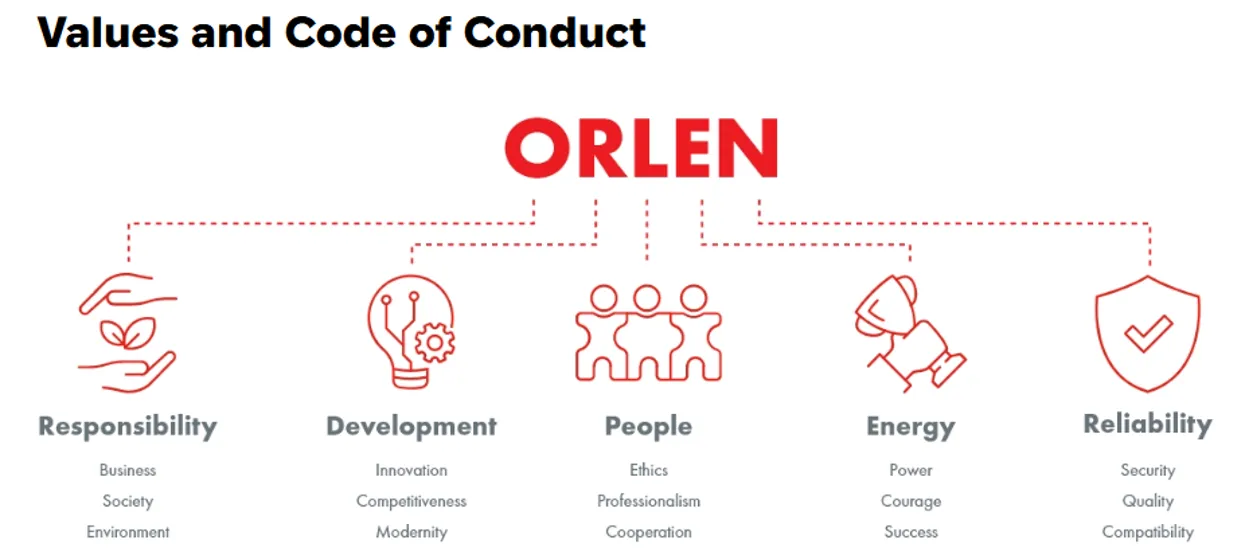
ORLEN Group Values
ORLEN Group Code of Ethics
Our Code of Ethics sets out clear, practical and up-to-date guidelines defining standards of conduct applicable to all employees, in alignment with the Group’s core values.
The Code also articulates our position on the ethical principles and standards governing the Group’s activities, as well as their current scale and strategic direction, expectations towards our business partners, and best practices in business ethics. As at the end of 2025, the Code of Ethics was in place at 85% of ORLEN Group companies, with rollout to further companies planned for 2026.
Our Group maintains core policies and functions designed to support responsible business conduct. These include the ORLEN Group Human Rights Policy (“Human Rights Policy”), the Whistleblower Protection Policy, the ORLEN Diversity Policy, and the Ethics Officer function, all of which are described in disclosure S1. As at the end of 2025, the Human Rights Policy was a binding document in 89% of ORLEN Group companies, with further deployments planned for 2026.
Model for reporting and analysing enquiries, concerns and violations with respect to the ORLEN Group’s core values and standards.
The model also applies to external stakeholders and can be accessed via our corporate website. To ensure compliance with ethical principles and the protection of human rights, we have implemented and maintain mechanisms for reporting enquiries, concerns and violations. The reporting procedures provide multiple voluntary channels for disclosing irregularities that have led, or may lead, to violations concerning ethics, human rights, employee relations or personal rights within the ORLEN Group. Our organisation guarantees confidentiality and security for individuals who report or disclose information on violations, while also committing itself to an effective and thorough remedial process and the implementation of corrective measures.
The ORLEN Group Code of Ethics, the ORLEN S.A. Workplace Bullying, Discrimination and Harassment Prevention Rules, and the Human Rights Policy set out mechanisms for identifying, reporting, and investigating concerns related to unlawful conduct or behaviours inconsistent with our values. In addition to the Code of Ethics, we have established the role of Ethics Officer as well as an Employee Relations Committee.
Furthermore, to maintain the highest standards, we are committed to exercising appropriate due diligence with respect to human rights throughout our business activities and relationships, including in the planning and execution of new investment projects. In 2025, no reports concerning human rights violations were recorded within the ORLEN Group.
Report an enquiry, concern or violation with respect to the ORLEN Group’s core values and standards

Model for reporting and analysing enquiries, concerns and violations with respect to the ORLEN Group’s core values and standards

Training and educational initiatives within the ORLEN Group conducted as part of the established policies and procedures governing ethics, human rights, diversity, and the prevention of workplace bullying, discrimination, and all forms of harassment
We carry out these initiatives at ORLEN S.A. and other Group companies in line with our established policies and procedures addressing ethics, human rights, diversity, and the prevention of workplace bullying, discrimination, and all forms of harassment. These include employee training sessions, workshops, educational briefings, competitions and awareness-raising events, mandatory training, communication campaigns, and cooperation with various business areas to promote best practices in these fields. Collectively, these initiatives play a significant role in shaping our organisational culture and fostering an environment of trust and security among our employees, particularly those from minority groups who may be at greater risk of unequal treatment or discrimination.
In 2025, we carried out the following employee training sessions and educational initiatives:
- mandatory e-learning on the ORLEN Group Code of Ethics, completed by 81% of ORLEN S.A. employees (with a requirement for all employees to complete the training at least once every three years);
- mandatory training on the ORLEN Group Code of Ethics, attended by a total of 68% of ORLEN Group employees (with a requirement for all employees to complete the training at least once every three years);
- mandatory e-learning on the Human Rights Policy, completed by 95% of ORLEN S.A. employees (with a requirement for all employees to complete the training at least once every three years);
- training on the Human Rights Policy, attended by 71% of ORLEN Group employees (with a requirement for all employees to complete the training at least once every three years);
- mandatory training on workplace bullying prevention – completed by 82% of ORLEN S.A. employees (with a requirement for all employees to complete the training at least once every three years);
- additional recurring training dedicated to workplace bullying prevention for ORLEN S.A. management staff;
- ‘Introduction to AI’ training sessions, including a module on ethics, attended by 1,262 participants.
In addition, a series of preventive sessions was launched to reduce the risk of inappropriate behaviours among ORLEN S.A. employees. The initiative will be continued in subsequent years. Throughout 2025, we also organised a range of educational events at ORLEN S.A., including the Ethics Days, Diversity Festival, and webinars aimed at increasing awareness of psychological safety, inclusive communication and neurodiversity.
The Diversity Charter and the Charter on the Rights of Children in Business
On 14 December 2023, ORLEN S.A. became a signatory to the Diversity Charter – a European Commission-supported initiative promoting equality and diversity management in the workplace. It is implemented in 26 European Union countries, with the programme in Poland coordinated by the Responsible Business Forum.
The Charter is a written commitment signed by an organisation obliging it to prohibit workplace discrimination. By adopting the Diversity Charter, we explicitly demonstrate our commitment to actively fostering diversity and engaging our entire workforce, along with our business and social partners, in these efforts. Following its adoption, in 2024 we initiated strategic planning to fulfil our commitments, foster diversity, and further enhance our organisational culture. These plans will be executed over the coming years.
On 24 January 2024, we became a signatory to the Charter on the Rights of Children in Business, a new initiative in Poland developed by the Responsible Business Forum in collaboration with businesses and social organisations. By endorsing the Charter, we have committed to respecting children’s rights throughout all aspects of our corporate activities. Among other objectives, we aim to create a supportive and inclusive workplace for parents, assist our employees in balancing their parental and professional responsibilities, and promote responsible employment practices. In connection with this commitment, ORLEN has implemented initiatives focused on children’s rights in business, primarily directed at employees in their roles as parents and caregivers.
Management of relationships with suppliers [G1-2]
In performing its tasks, the ORLEN Group’s Procurement Area operates in accordance with a comprehensive framework of internal regulations, including the Procurement Policy, Procurement Guidelines, Supplier Evaluation Guidelines and Strategic Category Management Guidelines. A key pillar of our procurement processes is to build and maintain stakeholder trust. Accordingly, suppliers are required to operate in compliance with applicable laws and the highest ethical standards.
All suppliers seeking to participate in our procurement procedures are required to review and formally accept the relevant policies and regulations. This is a mandatory criterion, verified at the initial stage of each procurement process as part of the supplier’s formal eligibility assessment. Supplier evaluation is conducted in accordance with criteria defined in the applicable Code.
In addition, our contracts with suppliers include clauses addressing a range of issues, such as environmental protection, occupational health and safety, sanctions compliance, anti-corruption and beneficial ownership disclosures.
We place great importance on stakeholder trust. Accordingly, we require our suppliers to operate in line with the values, ethical standards, and legal requirements set out in the ORLEN Group Code of Conduct for Suppliers.
We require all suppliers participating in our procurement processes to familiarise themselves with and accept the ORLEN Group Code of Conduct for Suppliers, the Human Rights Policy, and our anticorruption regulations. These represent formal criteria applied in the procurement processes. The criteria detailed in the Code address key environmental, social, and corporate governance (ESG) considerations. Our suppliers are evaluated based on these criteria.
Payment practices [G1-6]
We have established internal policies governing payment practices at ORLEN Group companies, including standard payment terms aligned with market norms relevant to each of our business segments. To ensure the timely settlement of liabilities, general policies have also been implemented to govern our accounts payable process, supported by detailed operational procedures and guidelines.
There is no standard payment term across the ORLEN Group. In 2025, standard payment terms across the ORLEN Group ranged from 7 to 90 days. This variation reflects the scale and diversity of the Group’s operations, as part of which it works with suppliers across multiple countries, sectors and industries. Payment terms are also influenced by the legal and regulatory environments of individual markets. They are determined on a case-by-case basis, taking into account the nature of the goods and services provided, as well as the specific requirements and contractual arrangements.
The information presented below on payment practices at the ORLEN Group, calculated as the weighted average of payments meeting the standard in a representative sample of four companies, covering approximately 78% of total payments across the Group.
Percentage of payments aligned with standard payment terms at representative Group companies
| Number of the undertaking’s payments | Number of payments aligned with standard payment terms | Percentage of payments aligned with standard payment terms | Average time the undertaking takes to pay an invoice from the date when the contractual or statutory term of payment starts to be calculated | |
|---|---|---|---|---|
| ORLEN Group | 2,428,522 | 1,482,828 | 61.06% | 30.87 |
There is no data regarding payment practices for the ORLEN Group for 2024.
In 2025, the ORLEN Group was involved in 36 court proceedings related to late payments.
With regard to payment practices, we do not differentiate between small and medium-sized enterprises (SMEs) and other suppliers. Information on payment terms and the settlement of liabilities is therefore presented on an aggregated basis for all suppliers.
Prevention and detection of corruption and bribery [G1-3]
We structure our anti-corruption process at the ORLEN Group as a cycle of interconnected activities comprising four stages: prevention, identification, verification or investigation, and calibration. Establishing anti-corruption awareness is a fundamental component of this framework. This awareness underpins the identification of misconduct, which occurs via two principal channels: stakeholder reports submitted through whistleblowing or other grievance mechanisms, and systemgenerated alerts from our corporate applications. Following initial assessment, identified cases are directed either to verification or to formal investigation as part of follow-up actions.
Investigative processes aim not only to confirm or exclude instances of misconduct, but also to identify patterns and methods (modus operandi) associated with corruption and fraud. These insights are subsequently integrated into our systemic controls through calibration of the corporate applications. The Anti-Corruption Policy is designed both to prevent incidents and to mitigate their potential negative impacts. Contractors and participants in our procurement processes are required to declare the absence of any conflicts of interest and affiliations with other contractors involved that could compromise the integrity of the procurement procedure. The inclusion of anti-corruption clauses in contracts facilitates ongoing monitoring of contractors, enabling potential corruption incidents to be promptly detected and addressed. The application of anti-corruption clauses is recommended across the entire ORLEN Group.
The ORLEN Group Whistleblower Protection Policy and internal reporting regulations ensure the independent investigation of reports and appropriate follow-up actions. Where reports involve the activities of our Management Board at ORLEN S.A. or the Management Board of another ORLEN Group company, follow-up actions are carried out under the supervision of the respective Supervisory Board.
The Rules of Procedure for the Supervisory Board set out the responsibilities of the Security Committee, which include receiving reports on the implementation of the ORLEN Group Anti- Corruption and Fraud Prevention Policy. Our Group companies maintain internal regulations that govern reporting to administrative, management, and supervisory bodies, and report annually to ORLEN S.A. regarding their implementation of the Anti-Corruption Policy.
The ORLEN Group Conflict of Interest Management Policy defines a list of positions subject to a conflict-of-interest assessment, which also correspond to roles with the highest corruption risk. Individuals occupying such positions are required to disclose any relationships that may give rise to conflicts of interest, enabling appropriate oversight and management by their superiors.
We provide mandatory anti-corruption training to all Group employees. Within the Control and Security Area, designated employees receive training in the handling of whistleblowing reports and the protection of whistleblowers.
Our Group companies communicate the ORLEN Group Anti-Corruption and Fraud Prevention Policy in line with their internal procedures. The Policy’s key principles are communicated primarily through mandatory anti-corruption training sessions.
To ensure appropriate stakeholder awareness, these core principles are also published via internal media and on the websites of ORLEN Group companies.
Training guidelines are issued by the ORLEN S.A. Control and Security Area. Internal training programmes are conducted based on requirements identified as part of the preparation of an annual training plan. Mandatory anti-corruption training covers all our employees, while extended training programmes are also provided to management and individuals in positions with the highest corruption risk. In the reporting year, 64.20% of employees in such high-risk roles participated in dedicated training across the ORLEN Group. We also provide training on our Whistleblower Protection Policy. Members of the Management Board and Supervisory Board are likewise covered by anti-corruption training programmes.
The training content includes the key regulatory components of our anti-corruption framework:
- ORLEN Group Anti-Corruption and Fraud Prevention Policy,
- ORLEN Group Whistleblower Protection Policy,
- ORLEN Group Conflict of Interest Management Policy,
- ORLEN Group Policy for Accepting and Offering Gifts.
For members of the governing and supervisory bodies at ORLEN S.A., training is further supplemented with elements of the Rules of Procedure for the Management Board and the Remuneration Policy for Members of the Management Board and Supervisory Board, as adopted by the General Meeting.
Incidents of corruption or bribery [G1-4]
To address potential violations, we operate a comprehensive anti-corruption framework based on the policies outlined in disclosure G1-1. In addition, to strengthen awareness of anti-corruption and fraud prevention, our employees are required to complete mandatory, recurring training programmes. Relevant policies are also made publicly available to our external stakeholders via the ORLEN website.
During the reporting period, no convictions were recorded for violation of anti-corruption and antibribery laws.
Political influence and lobbying activities [G1-5]
Our representatives engage in consultations regarding proposed measures at both national and EU levels, either directly or through industry associations. Positions developed by ORLEN experts are publicly available under Our positions.
In line with our Compliance Policy, the Executive Director for Regulatory Affairs and Compliance oversees lobbying activities conducted by ORLEN S.A. and supervises such activities within the ORLEN Group.
Pursuant to Section 3.5.4 and 3.5.5 of the ORLEN Charitable Policy, the provision of direct support for political purposes is strictly prohibited. We do not review requests for donations from trade unions, professional self-governments, employer organisations, commercial-law companies other than those specified in Section 3.4.6 (i.e. entities established by public finance sector units), political parties, or foundations and associations established by political parties.
In 2025, no donations to political parties, politicians, or institutions of a similar nature were identified. At the Group level, a related framework – Organisational Standard for Delivery of the Charitable Policy by Companies of the ORLEN Group – is in place, under which all entities conduct their charitable activities in accordance with the ORLEN Charitable Policy, as described in disclosure S3.
ORLEN Group entities operate across the oil and gas, energy generation and energy services, chemicals and biofuels sectors. Within these areas, our Group maintains an ongoing and transparent dialogue with a range of external stakeholders, including governmental authorities, European Union institutions, and other third parties. We are an active member of industry organisations and associations engaged in public policy advocacy on climate change and other areas, aiming to shape a comprehensive policy and regulatory framework relevant to ORLEN’s operations. Key organisations include: CO2Value Europe, Hydrogen Europe, the European Fuels Manufacturers Association, the International Association of Oil and Gas Producers, the European Chemical Industry Council (CEFIC), the European Fuels Manufacturers Association, the Polish New Mobility Association, POPiHN – the Polish Oil Industry and Trade Organisation, and the Polish Chamber of Chemical Industry. Our representatives participate in these organisations as subject-matter experts, contributing to consultations and providing input on proposed regulatory solutions.
In the EU transparency register, ORLEN is registered under number 105450620110-21.
Key topics addressed through lobbying activities and ORLEN’s principal positions in this regard are presented below.
Draft Act Amending the Aviation Law and Certain Other Acts
We advocated, among other things, for a revision of the definition of an ‘aviation fuel supplier’ and the introduction of a mechanism allowing specific batches of sustainable aviation fuel (SAF) to be credited towards the National Indicative Target (NIT). We also emphasised the need to establish clear rules for documenting compliance with the SAF blending obligations and to clarify provisions concerning penalties for non-compliance.
Draft Act Amending the Act on Preventing Pollution from Ships and Certain Other Acts
Our involvement was limited to submitting comments mainly in relation to: changes in the legislative drafting techniques for incorporating certain definitions from the FuelEU Maritime Regulation, removal of the requirement to hold a copy of the written registration confirmation, and clarification of interpretative uncertainties regarding the application of FuelEU Maritime obligations to vessels moored at the quay in the port of call.
Draft Regulation on the minimum share of biocomponents in liquid fuels used in all modes of transport
We advocated for maintaining the existing mandatory blending level at 5.2%, noting that provisions of the Biocomponents and Liquid Biofuels Act exclude the recognition of biofuel components obtained through the HVO process and those derived from feedstocks listed in Annex 1 to the Act.
Draft Regulation of the Minister of Industry and the Minister of Climate and Environment on quality requirements for liquefied natural gas (LNG)
We highlighted that while the regulation constituted a vital element of the fuel quality monitoring and control system and its prompt adoption was both justified and necessary, its effectiveness depended on the adoption of two accompanying regulations governing LNG sampling methods and testing procedures, which would complete this framework enabling practical evaluation of LNG quality by the Trade Inspection Authority.
Draft Act amending the Act on Reserves of Crude Oil, Petroleum Products, and Natural Gas and on Measures to Address Threats to the State’s Fuel Security and Disruptions in the Oil Market and Certain Other Acts
We supported the proposed partial transfer of the obligation to maintain physical stocks of crude oil and refined products from producers and traders to the Government Strategic Reserves Agency (RARS), as the proposed changes would not only reduce company costs but would also alleviate industry demand for private storage capacity. Moreover, the reform is expected to positively impact the storage market by reducing storage costs, improving control over reserves, and enabling more efficient allocation of stocks according to demand.
Draft Act Amending the Act on Taxation of the Extraction of Certain Minerals
We proposed extending the tax reform to cover natural gas and crude oil extraction, which would support the strategic role of domestic gas and oil production in ensuring supply security, price stability, and Poland’s energy transition.
Draft Regulation of the Minister of Energy amending the Regulation on the detailed list of liquid fuels whose production, storage or handling, transmission or distribution, or trade, including foreign trade, requires a licence and whose import requires entry in the register of importing entities
We advocated for extending the scope of the amendment to address the main issue currently affecting the Polish LPG fuel market, namely that of increased imports of n-butane (CN code 2901 10 00) from Russia, used so far in the cosmetic industry or laboratory applications, and currently as a substitute for LPG subject to EU sanctions.
Draft Act Amending the Act on Monitoring and Control of Fuel Quality and the Act on the National Revenue Administration
We proposed expanding the statutory definition of ‘heavy fuel oils’ to include products classified under CN code 2707 (subheadings CN 2707 99 19, 2707 99 91 and 2707 99 99), which are currently omitted from the draft legislation.
Draft Act Amending the Assay Law and the Law on Measures We proposed introducing provisions to supplement the existing Act of 11 May 2001 – Law on Measures by enabling ‘assisted verification’ by metrology authorities at the user’s request to confirm that serviced measuring instruments remain compliant and can be used without requiring recertification.
Draft Act Amending the Act on the Monitoring System for the Carriage of Goods by Road and Rail and on Fuel Oil Trading, and Certain Other Acts
We submitted proposals to maintain exemptions from the obligation to report intra-warehouse transfers of goods to the road and rail transport and trade monitoring system (SENT), as well as to exclude from SENT goods moved within the territory of Poland under the e-DD document. Furthermore, we proposed extending the monitoring system to cover the transport of fertilisers, amending the rules governing the deadline for closing SENT notifications, and clarifying the scope of data required to be provided in this process.
Draft Act Amending the Act on the GHG Emission Allowance Trading System and Certain Other Acts (ETS1)
We advocated for extending the application of a zero emission factor beyond biofuels, bioliquids and biomass fuels to include RFNBOs, recycled carbon fuels (RCF), low-carbon synthetic fuels, and blended fractions, subject to demonstrated compliance with relevant sustainability criteria and – depending on the sector – with greenhouse gas reduction criteria.
Draft Act Amending the Energy Efficiency Act and Certain Other Acts
We focused on issues related to the alternative compliance fee and the functioning of the white certificates market, proposing removal of the requirement to place purchase orders for white certificates in all trading sessions as a condition for being allowed to pay the fee.
Draft Act Amending the Capacity Market Act
Our position submitted to the government included proposals aimed at facilitating investor participation in capacity auctions and enabling the contracting of stable generation capacity.
Draft Act Amending the Energy Law and Certain Other Acts
Our position submitted to the government, both directly and through industry associations, supported the proposed amendments, particularly in view of the planned commissioning of new generation assets.
Draft Act Amending the Energy Law and Certain Other Acts
Our position, submitted directly or through industry associations, included comments on expanding the list of exemptions from mandatory trading obligations.
Draft Act Amending the Act on the GHG Emission Allowance Trading System and Certain Other Acts
We proposed provisions that would allow budget revenues from the sale of CO₂ emission allowances by Poland to be allocated to investments in nuclear energy, including small modular reactors (SMRs), as part of climate-related expenditure.
Draft Act Amending the Act on the Promotion of Electricity Generation in Offshore Wind Farms and Certain Other Acts
We provided comments aimed at increasing the likelihood of conducting an offshore wind auction in December 2025 and improving the economic viability of offshore wind projects.
Draft Act on Artificial Intelligence Systems
We highlighted the need to introduce minimum environmental standards for newly built data centres based on recognised international benchmarks, incentives (e.g. state aid) for new investment projects, and the development of energy-efficient data centre locations.
Draft Act Amending the Act on the Education in Sobriety and Alcoholism Prevention
We emphasised the need for measures to reduce alcohol consumption within society, while noting that both the statutory regulations proposed by the government and those sponsored by MPs target only selected sales channels and may therefore prove to be ineffective. We advocated for comprehensive, horizontal regulation applicable to all market participants.
Draft Act Amending the Act on the National Labour Inspectorate and Certain Other Acts
We pointed to risks associated with the proposed immediate enforceability of labour inspector decisions and the need to clarify criteria determining the actual existence of an employment relationship. Work on the draft legislation has been suspended.
Draft Act Amending the Land Surveying and Cartography Law and the Spatial Information Infrastructure Act
Our comments related to proposed legislative solutions concerning closed areas.
Act of 3 February 1995 on the Protection of Agricultural and Forest Land and the Construction Law of 7 July 1994
We advocated for administrative simplifications for hydrocarbon extraction activities.
Act of 9 January 2025 on Special Solutions for Counteracting Support for Aggression against Ukraine and Protecting National Security, the Act on National Revenue Administration, and the Act on the Prevention of Money Laundering and Terrorist Financing
We submitted comments highlighting the need for clarification of certain aspects, including the scope of required declarations, risk determination, and implications for third countries.
In 2025, our key regulatory positions at the EU level, in the context of ongoing legislative processes, concerned the following key regulations:
Regulation (EU) 2023/1115 of 31 May 2023 on the making available on the Union market and export from the Union of certain commodities and products associated with deforestation and forest degradation
We advocated for a simplification of administrative obligations and deferred application of the regulation’s provisions.
Amendment to the European Climate Law and the proposed 2040 climate target
We argued that the proposed target of a 90% reduction in emissions by 2040 compared with 1990 levels exceeds the realistic technological, financial and political capabilities, and therefore should be set at a lower level. We also called for greater flexibility in supporting mechanisms, including the use of international carbon credits and application of the technological neutrality principle.
Revision of the EU Emissions Trading System
We advocated for maintaining the international competitiveness of industrial installations covered by the EU ETS through mechanisms ensuring a level playing field for EU and non-EU entities. This would involve increasing the volume of free allowances allocated to sectors exposed to carbon leakage, providing compensation for indirect costs, improving market liquidity through adjustments to the Linear Reduction Factor (LRF), and revising the Market Stability Reserve (MSR) to prevent depletion of allowances in 2039/2040. We also called for delaying the implementation of the system until alternative solutions in the transport and heating sectors are sufficiently developed, which could help mitigate the cost impact of ETS2.
Regulation on phasing out Russian natural gas imports and preparing the phase-out of Russian oil imports, improving monitoring of potential energy dependencies and amending Regulation (EU) 2017/1938
We advocated for shortening transitional periods, limiting the scope of the suspension clause, which could potentially undermine the overall effectiveness of the regulation, tightening controls over gas flows to prevent the transmission of Russian gas disguised as originating from other sources, introducing financial penalties to ensure a deterrent effect, and restricting permissible amendments to existing contracts.
Proposal to amend Directives 2006/43, 2013/34, 2022/2464 (CSRD) and 2024/1760 (CSDDD) with regard to certain sustainability reporting and due diligence requirements
We primarily advocated for complete removal of Article 22 of the CSDDD Directive and related provisions, as it would require both EU and non-EU undertakings to prepare and implement climate transition plans. In our view, retaining that requirement could negatively affect partnerships with non- European oil and gas companies, potentially leading to disruption of market stability, increased commodity prices, and reduced energy security in the EU.
Proposal for a Regulation of the European Parliament and of the Council amending Regulation (EU) 2019/631 as regards CO₂ emission standards for new light commercial vehicles and vehicle labelling, and repealing Directive 1999/94/EC
In the context of the proposal on CO₂ emission standards, we advocated, among other things, for increasing the role of e-fuels and biofuels in contributing to compliance with CO₂ emission targets, as well as for expanding the range of fuels meeting the relevant criteria, including recognition of the role of first-generation biofuels. In our view, this would, in particular, support the security of fuel supply chains, improve the availability and enable the use of locally sourced (i.e. European) inputs for biofuel production.
Proposal for the Multiannual Financial Framework for 2028–2034, together with the proposal for a Regulation of the European Parliament and of the Council establishing the European Competitiveness Fund
We believe the mechanism for allocating funding from the European Competitiveness Fund, particularly that dedicated to the energy transition, should reflect the scale of challenges faced by individual Member States and regions. For this reason, it is essential to establish national and/or regional allocation envelopes.
Regulation (EU) 2025/1227 of the European Parliament and of the Council on the modification of customs duties applicable to imports of certain goods originating in or exported from the Russian Federation and the Republic of Belarus
Our key proposals included the immediate application of tariffs and the introduction of official monitoring of fertiliser imports, increasing ad valorem duty rates while simultaneously reducing the quotas required to trigger such rates, and extending trade measures to additional fertiliser products not covered by the European Commission’s proposal.
Draft Commission Implementing Decision laying down rules for the application of Directive (EU) 2019/904 as regards the calculation, verification and reporting of data on recycled plastic content in single-use plastic beverage bottles
We advocated, among other things, for expanding the range of substances recognised as recycled material to include all non-fuel products. In our view, this would enable manufacturers to declare recycled content in high-value products, rather than limiting such reporting to polymers only.
Communication from the European Commission amending the Guidelines on certain state aid measures in the context of the greenhouse gas emission allowance trading system post-2021
We proposed extending the list of entities eligible for compensation of indirect costs and removing the rule proposed by the Commission under which sectors covered by CBAM, including the fertiliser sector, would be excluded from compensation mechanisms.
Environmental Omnibus package We advocated for reducing the administrative burden associated with monitoring and reporting the environmental impact of installations, and for streamlining and accelerating the environmental permitting process for their operators.
Delegated act on grouped packaging and plastic straps supplementing Regulation (EU) 2025/40 on packaging and packaging waste (PPWR)
The position we presented emphasised the need to fully exclude pallet wrappings and straps from the reuse targets set out in Article 29(1), (2) and (3) for technical, operational, economic and environmental reasons.
Revision of the Block Exemption Regulation
We advocated for raising the aid intensity thresholds in respect of eligible project costs in areas such as heating sector decarbonisation, carbon capture and storage (CCS), and the promotion of renewable energy. We also called for extending eligibility to projects across the entire CO₂ value chain, including low-carbon hydrogen.
Draft Communication from the European Commission establishing a framework for state aid measures to support the Clean Industrial Deal
Through industry associations, we participated in the public consultation on the draft document, submitting comments on the need to incorporate criteria for the European Commission’s notification of state aid related to capacity mechanisms, taking into account the specific characteristics of the Polish energy market.
Draft Commission Implementing Regulation (EU) specifying the pre-qualification and award criteria for auctions for the deployment of energy from renewable sources
We submitted comments highlighting the need to recognise contributions to sustainability through the ownership – or demonstrated plans to develop – complementary generation assets by bidders, while also proposing clarifications to the wording of specific provisions.
Certain members of the ORLEN Supervisory Board simultaneously hold positions as Director General at the Ministry of State Assets and Deputy Director for Implementation of the Province of Warsaw’s Budget at the Marshal’s Office of the Province of Warsaw, within the Budget and Finance Department.
In addition, one Supervisory Board member, at the time of nomination, was employed as a Legal Advisor at the supreme state audit authority. Additionally, he was acting Deputy Director of the Legal and Audit Decisions Department at Poland’s Supreme Audit Office.
Additional entity-specific topic
Cybersecurity at ORLEN S.A. and the ORLEN Group in 2025
Our key document governing cybersecurity is the ORLEN Group ICT Security Policy, established to define the rules and requirements necessary to maintain the desired level of cybersecurity across the ORLEN Group. The document sets out the standards for cybersecurity management, introducing both general cybersecurity rules and detailed requirements and responsibilities relating to IT and OT assets.
Oversight of compliance with the Policy rests with Head of the Control and Security Office and Executive Director for IT, in line with their respective areas of responsibility. The Policy is distributed through an internal IT platform that enables users to confirm that they have read and understood the document. All ORLEN S.A. employees with access to ORLEN S.A.’s information and communications assets were required to complete an e-learning course covering the requirements and obligations assigned to them under the Policy. At the same time, all users of ORLEN S.A.’s information and communications assets were required to comply with the Policy.
Cybersecurity measures are designed to maintain the target level of cybersecurity. This is achieved not only by ensuring compliance with external legal requirements, but also through proactive threat identification, ongoing analysis, and responsive action to prevent and mitigate threats.
ORLEN SA. delivers cybersecurity services both internally and to other Group companies under a centralised operating model, based on an integrated approach combining regulatory requirements, technical solutions, processes and people. At the operational level, specialised roles and structures are in place, including CERT ORLEN S.A., responsible for incident response coordination, monitoring, and operational support for Group entities. Our cybersecurity efforts extend beyond defence and incident response, with a strong emphasis on proactive measures aimed at identifying threats and strengthening resilience before any incidents occur.
We coordinate cybersecurity activities in a manner that supports the delivery of business objectives, while ensuring resilience and continuity of our critical processes and services. This is achieved in particular through the analysis and mitigation of cybersecurity risks and the safeguarding of IT/OT system continuity. These activities include the continuous identification of threats, risks and incidents, their management, and systematic enhancement of protective, organisational and technical measures in place, supported by ongoing evaluation of security controls, readiness exercises, and organisational lessons learned.
In 2025, ORLEN S.A. initiated a process to expand its cybersecurity structures. A key initiative delivered by our Cybersecurity Office was the first edition of CyberSec Forum, an event serving as a platform for cooperation with state agencies and for intra-sector networking with other energy companies, aimed at developing consistent threat intelligence-sharing standards, procedures and mechanisms aligned with the objectives of NIS2 and the national cybersecurity system. The event was attended by both governmental and non-governmental representatives, as well as companies of the ORLEN Group. We also pursued a wide range of initiatives aimed at strengthening compliance with updated legal requirements, while also addressing our internal priorities and the evolving cybersecurity threat landscape. Activities of the Cybersecurity Office, including CERT ORLEN, are fully integrated with the broader Digital Transformation and IT function, supporting the delivery of our business objectives.
In 2025, a number of initiatives were undertaken to achieve compliance with the provisions of the draft amendment to the Act on the National Cybersecurity System. In the process, we identified areas requiring a modification of existing security controls or the addition of new technical and organisational measures.
Our cybersecurity-related objectives form part of the objectives pursued by the Digital Transformation and IT area. The primary and overarching goal is to ensure the availability of information and communications assets at the agreed level, while also maintaining the target level of cybersecurity for IT and OT systems. We also plan to implement a centralised cybersecurity management model at selected strategic Group companies in 2026, and in our value chain by 2030.